Friday, October 5, 2018

Halloween Horror Classics (The Return!)

Continuing our reviews for classic era horror movies, we have two treats for you today!  (Or is it a trick?)


The Man Who Laughs (1928)


Les Miserables, The Hunchback of Notre Dame…and The Man who Laughs?  The aforementioned titles were penned by the same author.  Though the latter is not as well known, it has gained a cult following for being considered an early horror picture of Universal.  Though this is somewhat an unfair assessment as The Man Who Laughs fits into several categories namely; Adventure, Romance, Dark Comedy, Horror and Drama.  However neatly these picture categories apply, it is filmed very much like a gothic horror film and demonstrates German expression so prevalent at the time.
For many years, Universal has been associated with horror. This began with two Lon Chaney vehicles in the silent period, The Hunchback of Notre Dame(1923) and The Phantom of the Opera (1925). It continued with the groundbreaking features Dracula (1931) and Frankenstein (1931) (more on these films later)  then through the 1940s "horror rallies," into the big bug science fiction features of the 1950s.

This consolidation of horror at Universal was helped along by many artists, including German expatriate director Paul Leni (1885-1929). One of the many Europeans who came to America during the 1920s, Leni first gained fame as a set designer and art director, and subsequently, a director. The owner of Universal, Carl Laemmle, became aware of his talents when he saw Das Wachsfigurenkabinett, a.k.a. Waxworks (1923), in which Leni atmospherically conjured up the nefarious exploits of Ivan the Terrible and Jack the Ripper.

Unlike many in the émigré community, Leni acclimated to Hollywood with apparent ease. The fact that the staff at Universal was filled with fellow Germans certainly helped. His first effort, The Cat and the Canary (1927), broke ground as the primal haunted house narrative. The establishing sequence remains undeniably spooky, as a tracking shot down an empty hallway resonates with impending calamity.

Sadly, Leni's residence in Hollywood was brought to a premature end in 1929, when he died from blood poisoning brought on by an untreated ulcerated tooth. Had he lived, one imagines he would have directed Universal's horror features during the early '30s. Instead, the pinnacle of his American career was the ornate and expert adaptation of Victor Hugo's 1869 novel, The Man Who Laughs. Kino Video has made this tour de force available on a DVD that includes a reconstructed and restored print made from film elements found in European archives. It illustrates, particularly for those unfamiliar with Leni's work or silent films generally, the level of technical sophistication filmmakers achieved before the advent of sound.

For the film, Lon Chaney was originally slated to play the part of Gwynplaine prior to the smash hit (and his best known role) The Phantom of the Opera (1925).  Despite Chaney's contract with Universal, production did not begin since Universal had failed to acquire film rights to the Hugo novel from the French studio Société Générale des Films. Chaney's contract was amended, releasing him from The Man Who Laughs but permitting him to name the replacement film, ultimately resulting in the 1925 The Phantom of the Opera.

For the film, Laemmle paired Leni with another preeminent German émigré, Conrad Veidt, who had appeared in a number of classic films, including The Cabinet of Doctor Caligari (1919). His costar was the demure heroine from The Phantom of the Opera, Mary Philbin. The actors worked with the studio's most talented and influential technicians, including production designer Charles Hall, who began his association with Leni on The Cat and the Canary. The Man Who Laughs also marked the first makeup assignment for Jack Pierce, the maestro who subsequently sculpted the features of Bela Lugosi, Boris Karloff, and Lon Chaney, Jr.

Film historian Carlos Clarens calls The Man Who Laughs "the most relentlessly Germanic film to come out of Hollywood," though that attribution calls to mind a more slowly paced, histrionic, and self-conscious film than the one Leni directed. He did draw upon the kind of subtle lighting effects and declamatory acting style one finds in German films, yet Leni integrates those techniques with the demands of the Hollywood system without compromising their effectiveness.
Any instance of chiaroscuro lighting, oppressively ornate decoration, or artificial composition works toward the film's themes. The initial sequences that delineate the death of Gwynplaine's father, his abandonment to the elements, and discovery of Dea, masterfully convey his oppression and catastrophe.
Leni proved himself to be equally skilled with actors. Veidt commands the screen; equipped with a set of oversized dentures that did not permit him to speak, he employs his eyes and stance to convey emotions, as well as the import of the subtitled dialogue. Baclanova, a veteran of the Russian stage, oozes unrestrained passion as the Duchess, and reminds us that much latitude for sensuality existed in Hollywood prior to the 1934 Production Code.

Leni's premature death coincided with the wholesale abandonment of silent filmmaking in Hollywood. You get the feeling when watching certain late silent films, which some very skilled technicians were wringing out all that was possible with a form of expression soon to be outmoded. The Man Who Laughs demonstrates that, however much we gained with sound, we lost opportunities that arise when storytelling prioritizes vision.
Film: ***
Effects (for their time): *****
Soundtrack (modern or original): ****
Story: *****

Overall though the film is great, (at an 4.25 overall star score) I felt it a bit lacking.  The make-up of Jack Pierce is phenomenal, and it is easy to see even in this early work of his, the genius of the man who would go on to inspire Hollywood make-up greats such as Rick Baker and Greg Nicotoro. 

The Sealed Room (1909)


Where does one begin with a film that was directed by the notoriously racist director D.W. Griffith?  Well, this film could also be considered comedy as well as horror.  Nothing spine tingling here.  Generally the older films play on emotions to incite fear in the viewer, and ask the question “what if?”  The “what if?” here is what if you were doomed to spend the rest of your days locked in a room with a lover?  Sure, the air would give out, and you would die of carbon dioxide poisoning, but the panic that would set in is somewhat unsettling.  It is a nerve wracking thought when you think about it.  However viewing this film, I really didn’t think of it.  Mainly because of the analysis below.
With a static camera for the scenes showing the various members of the castle’s staff residents, it’s fun to see twenty people frantically trying to squeeze themselves into the shot. Those afraid of overly melodramatic acting should take medication well in advance of watching, there is more hanky-waving and flouncing here to fell a hippo.
Beyond the makeup and outfits, there really aren’t any laughs here, the ending being rather alarmingly down-beat, though you can’t argue that the masons did a terrific job sealing the room in such a short time. Arthur V. Johnson (The King) steals the show, by being both hilarious and sinister in turn.
It is interesting to note that one of Griffith’s signatures is that the actors in a scene are directed to look “offstage” to the left or right, often denoting where the next scene will be playing from.  Generally awkward to watch on stage perform in this manner, it is a unique approach as entertainment made its way from theatre to film.
The music needs mentioning.  Egad!  How to put into words how absolutely terrible most of the accompanying soundtracks were that I found.  They were so distracting that I had a hard time watching the film.  None of them really fit in well with the action on the screen.  One I had pulled up actually had a woman reading the intertitles!  What a way to break the illusion of watching this in a theater in the early turn of the century!
If you do want to check out the film, be sure to watch THIS one.  The others have soundtracks that will greatly reduce your enjoyment of the film.

Also along for the ride as background characters are Mary Pickford who enjoyed a terrifically long career as an actress and was one of the biggest stars of the silent era. She later went on to form production company United Artists, along with Griffith, Charlie Chaplin, and Douglas Fairbanks.

Film: ***
Effects: * (none of note, the main effect of the hastily built wall looked cheap even by historic standards.)
Soundtrack: ** (The only descent one I found was a piano accompaniment, which is good and adds to the feeling of actually watching it back then, however it is limited in the dramatic score.)
Story: **** (What’s not to love about Poe?)

Overall score: 2.5 (Not great) if you are bored and want to be entertained by some light hearted comedy/ horror, watch some Scooby Doo mysteries instead.


Wednesday, October 3, 2018

Kickin’ It Old School

As a geek and a lover of all things 80’s, I absolutely loved Netflix’s series “Stranger Things”.  I loved the old school D&D, and it made me hungry to do some good old fashioned dungeon crawling.  Well, armed with a ton of Descent and some flyers, I hit the FLGS (Friendly Local Game Shop).  2 Months later, I received NO interest.  Not one text or email.  The gaming community around here is pretty large, and somewhat inclusive, so I was surprised that nobody wanted to game regularly for a game that all you have to do is show up.


So what is a busy dad to do?  Enter solo gaming.  But what would capture the spirit of the old D&D, and allow me to play in an hour or so.  That is when I found Four Against Darkness by Andrea Sfiligoi.  This game (technically a board game) filled the void perfectly.  Armed with 2 six sided dice, a pencil, and the rules, I was ready with my four heroes to take on the evil forces that lay in wait in the vast, dark labyrinth of the dungeon.

The old wizard sighed as he handed the lantern to the slim, cloaked figure standing next to him.  “No telling what foul creatures lie in wait for the unwary traveler, however the knowledge contained in the ancient halls of the deep is quite valuable.”  The cloaked figure looked at him warily.

“You said there will be treasure, and untold riches.” the elf said ruefully.  

“But not without cost.” the wizard smirked.  His long beard blew slightly in the breeze as the barbarian picked up his axe and hefted it onto his shoulder with a “huff”.

“As long as my foes will be driven before me and I am victorious, I care little about the treasure.” He said as he widened his stance as if preparing to enter battle right there.

The young warrior stepped up and clapped a hand on the barbarian’s bare shoulder.  “Steady on, the evil within this wretched place will surely know justice!” 

“Shall we then?” the cloaked figure stepped towards the entrance to the dark maze below.  

So for my first game, I picked a wizard, an elf, a warrior and a barbarian.  The entrance room held a trap that my elf attempted to unlock the secrets to and failed, allowing 2 spears to come shooting out of the walls and hurtle towards her.  Deftly, she was able to avoid both!

The next couple of rooms held no riches or monsters, but the third room contained a secret door which led to another area of the dungeon.  Fearing nothing my brave heroes stepped into the corridor beyond finding 6 Mushroom Men!  Dispatching them quickly, the moved forward and were ambushed by a medusa.  Succumbing to the gaze of the foul beast, the barbarian turned to stone!  Discovering a chamber beyond the dreaded snake-haired creature, the four brave explorers found a small chest of coins and gems!

Retracing their steps, the heroes discovered an altar,  which promptly led the elf to see what she could discover only to find it cursed.  Reaching further into the depths of the dungeon, the explorers faced Orcs (which the wizard killed all 5 with a single fireball spell!), Hobgoblins, Skeletal rats.  But it was the dreaded vampire frogs that landed enough wounds onto the mighty warrior to cause his demise.  Venturing further, the remaining heroes easily defeated 3 Hobgoblins, and decided discretion was the better of valor, and began to make their way out of the dungeon.

Once in the village, the found they obtained enough wealth to receive a blessing allowing the barbarian to return to his old self.

All in all, this is a great game!  I was able to play and interact in conversation and watch TV with my family.  So much fun!

Tuesday, October 2, 2018

Classic era horror


Two reviews for one low price!
Many of the classic films that I will be reviewing were greatly influenced by German expressionism, with tonality and atmosphere playing a big part of “what is scary” about these classic movies. For scoring purposes, I am grading each film on a four part scale. 
Overall film quality - The general tone of the movie, and how it makes one feel.
Effects – How good are the effects? (Taking into account the technology at the time the film was made.)
Soundtrack – (Modern or original) Did the music help create atmosphere or distract from the overall theme of the movie?
Story – How well is the story told? Is it one that holds up to today’s hardened audiences?

Up first, L’Inferno (1911)
Hell, in many religious and folkloric traditions, is a place of torment and punishment in the afterlife. Religions with a linear divine history often depict hells as eternal destinations while religions with a cyclic history often depict a hell as an intermediary period between incarnations.
Hell is the setting of “The Divine Comedy” by Dante. Since this review is for the film based upon the epic poem, we won’t go into the history of the story too much and, focus more upon the film.
L'Inferno has the distinct title of being the very first feature film. Clocking in at over an hour, it becomes more unsettling the further you travel with Virgil and Dante.
Throughout L’Inferno, the camera remains wide and locked down like the proscenium of a stage. Instead, they focused their efforts on creating gloriously baroque sets and costumes. Much of the film looks like it was pulled straight from Gustave Dorè’s famed illustrations of The Divine Comedy. Yet seeing a picture in a book of a demon is one thing. Seeing it leap around lashing the naked backs of the damned is something else entirely. If you were ever tempted by the sin of simony, you’ll think twice after seeing this film. The use of the human form as both set dressing and scenery is unsettling to say the least. The imagery of writhing naked bodies coupled with the tinting process of various scenes unlocks a deep psychological horror within oneself that borders on everything we love about the Halloween season. The main feelings one experiences being the macabre, primal fear, and man’s basest evils. The sountrack of the edition I watched would be considered more modern, however it does not feel like it when coupled with the film.
L’Inferno – became both a critical and commercial hit worldwide, raking in over $2 million (roughly $48 million in today’s money) in the US alone. “We have never seen anything more precious and fine than those pictures. Images of hell appear in all their greatness and power,” gushed famed Italian novelist and reporter Matilde Serao when the film came out.
American film critic for The Moving Picture World, W. Stephen Bush, was even more effusive:
“I know no higher commendation of the work than mention of the fact that the film-makers have been exceedingly faithful to the words of the poet. They have followed, in letter and in spirit, his conceptions. They have sat like docile scholars at the feet of the master, conscientiously and to the best of their ability obeying every suggestion for his genius, knowing no inspiration, except such as came from the fountainhead. Great indeed has been their reward. They have made Dante intelligible to the masses. The immortal work, whose beauties until now were accessible only to a small band of scholars, has now after a sleep of more than six centuries become the property of mankind.”
Of course, the film’s combination of ghoulishness and nudity made it ripe to be co-opted by shady producers who had less that lofty motives. Scenes from L’Inferno were cut into such exploitation flicks as Hell-O-Vision (1936) and Go Down, Death! (1944).
Film: *****
Effects (for their time): ****
Soundtrack (modern or original): *****
Story: ****
Overall achieving a score of 4.5, the film is very surreal and unsettling even by today’s standards. You can watch the full movie here. Be sure to watch to the end where a triple mouthed Satan himself can be seen devouring Judas, Brutus and Cassius!


Since ancient times, ghost stories—tales of spirits who return from the dead to haunt the places they left behind—have figured prominently in the folklore of many cultures around the world. A rich subset of these tales involve historical figures ranging from queens and politicians to writers and gangsters, many of whom died early, violent or mysterious deaths. 
As far back as the very origins of film —to 1896, when French special-effects genius Georges Méliès made the three plus minute short above, Le Manoir du Diable (The Haunted Castle, or the Manor of the Devil). Méliès, known for his silent sci-fi fantasy A Trip to the Moon—(Referenced many times in various pop culture tributes!)—used his innovative methods to tell a story.
Maurice Babbis at Emerson University journal Latent Image, of “a large bat that flies into a room and transforms into Mephistopheles. He then stands over a cauldron and conjures up a girl along with some phantoms and skeletons and witches, but then one of them pulls out a crucifix and the demon disappears.” Not much of a story, granted, and it’s not particularly scary, but it is an excellent example of a technique Méliès supposedly discovered that very year.
According to Earlycinema.com,
In the Autumn of 1896, an event occurred which has since passed into film folklore and changed the way Méliès looked at filmmaking. Whilst filming a simple street scene, Méliès camera jammed and it took him a few seconds to rectify the problem. Thinking no more about the incident, Méliès processed the film and was struck by the effect such a incident had on the scene - objects suddenly appeared, disappeared or were transformed into other objects.
Thus was born The Haunted Castle, technically the first horror film, and one of the first movies—likely the very first—to deliberately use special effects to frighten its viewers.
Méliès’ work (though it may be considered rudimentary with the advancements of special effects in modern cinemas) still holds up today. I believe this is due to the primary reason of storyline. In my quest for old spooky movies, I have found that the story relies heavily on fright by emotion and tone, not by sudden, shocking imagery that you will find in most modern horror films.
Film: ****
Effects (for their time): *****
Soundtrack (modern or original): ***
Story: ***
So scoring an overall score of 3.75 stars, Le Manoir du Diable (1896) Was and is a great horror movie to this day as long as you take into account the “new technology” of that time period. It is nearly 125 years old after all! I can only hope to create something that would be in use 125 years later!
                             

Friday, August 26, 2016

More Mini Dungeon


A few more Mini Dungeon Adventures minis!
Orc!


Orc and Elf!

Mini dungeon Adventures


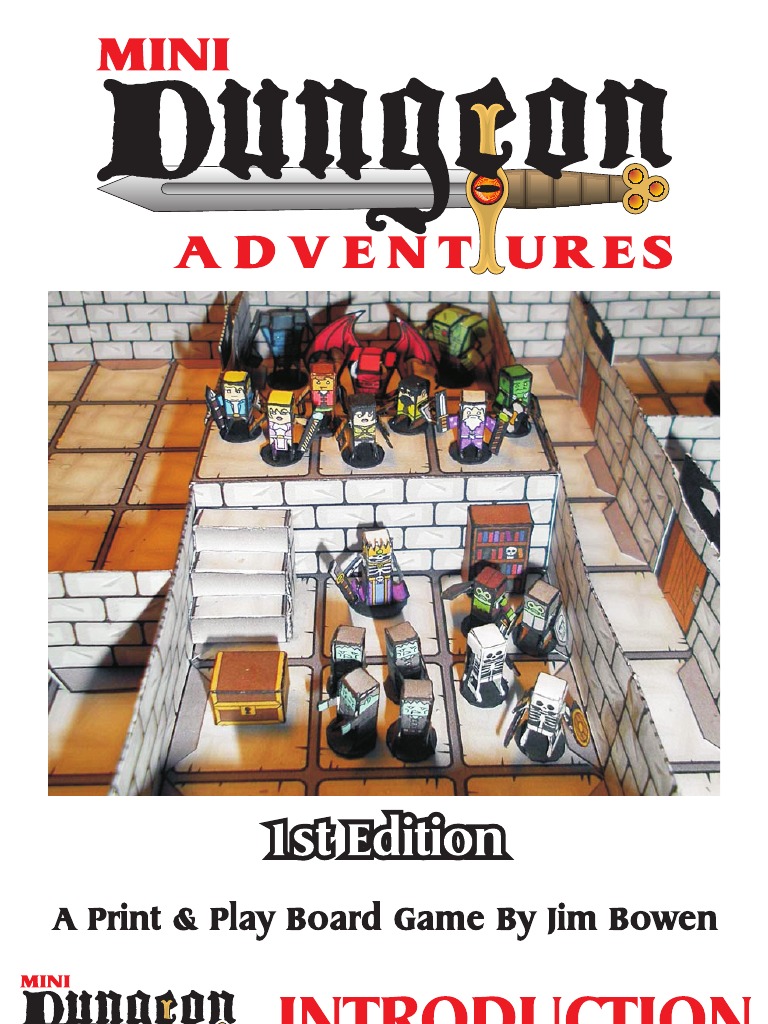
So I like papercraft and I like gaming.  When you combine the two, wonderful things can happen.  So, while surfing the interwebs, I came across this little gem called Mini Dungeon Adventures by Jim Bowen.  It's like a dungeon crawl game, but really tiny and FREE!  I promptly downloaded it, printed it, and began working on assembly.

Man, these things are tiny!  The dwarf (or dorf as in game) is smaller than a Lego guy head!  All in all great fun to put together.  I can't wait to play!  The rules look simple and hearken back to the days of Warhammer Quest/ A D&D!  There is also an expansion available, along with pretty decent community support.  In addition, there are other minis to download and print. There is even a gelatinous cube mini! The first two I assembled were the wizard and the dwarf.  Personally, I think they are kind of cute.

Enjoy some pics!


Wednesday, August 24, 2016

IDW? Really?

I'm a DC comics guy. Sure, I like an occasional Marvel title, but my real love is of DC heroes. (Even though The Green Hornet is one off my independent favorites.


So when I heard about IDW's Backt to the Future comic, I figured I would try it with a little trepidation. Gotta say I loved it! One of the creators from the film Bob Gale writes for it, an the art is quirky. I can hear Christopher Lloyd and Michael J. Fox in my head as I read it! It answers questions I didn't know I had about BTTF. For instasncr how did Marty and Doc meet? Didn't his parents ever wonder what happened to Calvin "Marty" Klein? Etc...
So I decided after reading 11 issues in one sitting to check out some other IDW titles. Up next, Ghostbusters!


Again, a great book! An awesome throwback to my favorite paranormal experts of the 80's! Great art, good storyline, and great layout! So what else did IDW have to offer?

Enter Mars Attacks! Occupation. 

Takes place several years after the movie and I loved the wacky, camp factor of the movie and trading cards. Is time the Martians have conquered earth. And once again IDW has me hooked. Great art storyline and layout. Visually very pleasing.  Lots of unique camera angles. So what else is a guy like me to do when I find out its only a short 5 issue series? Find another title that has some staying power.


So far so good. A classic at has been updated in a good way. All in all, great art and story. Though, I am not very far into it yet, I love it so far.


Wednesday, August 17, 2016

Green Lanterns #004 Review


So I am trying to still get caught up on my reading.  Today we look at Green Lanterns #4.  I am not sure what I think about the buddy cop mix matched pair 80's movie plot line.  But the action is good, and the whole Red Lanterns bad guy thing is pretty awesome.  Artwork 9/10 again, I love how they draw the ring's power.  Characterizations 7/10 I am still out on Jessica something tells me even though she is a big time rookie with no willpower, she will turn out to be pretty sweet.  Layout 5/10 standard.  Some good splash pages.  Story 8/10  I am still interested to see where it is going so that counts for a lot.

Overall score... Man-e-Faces on the He-man 80's Cartoon Scale.